
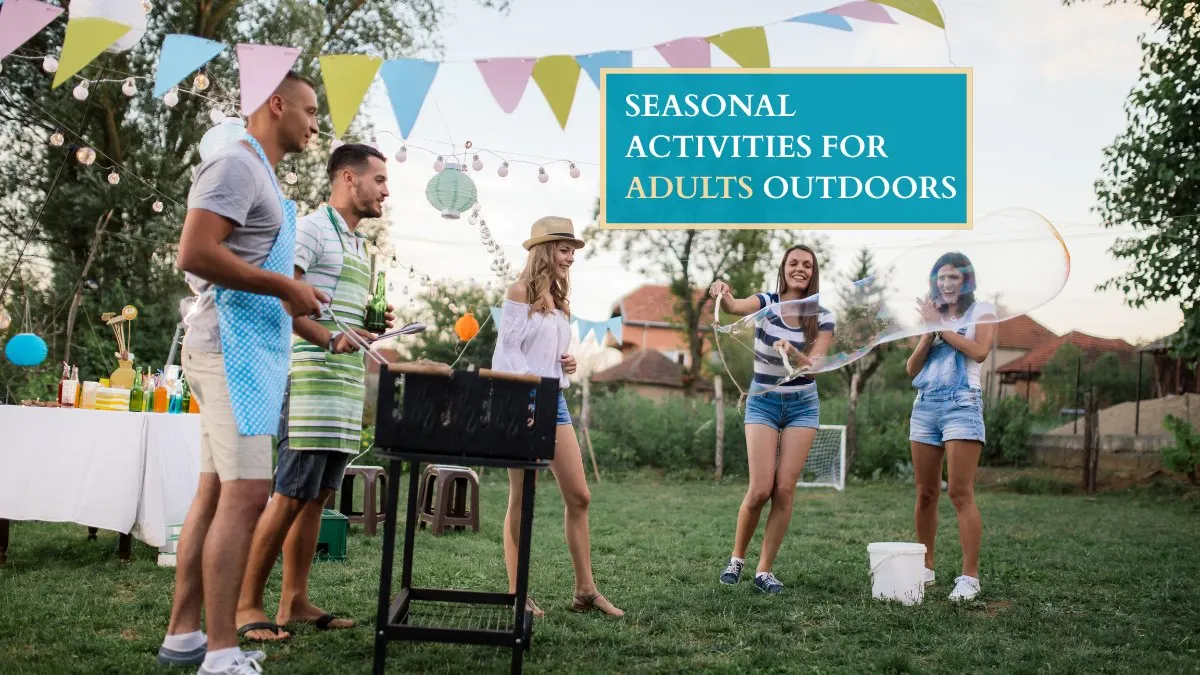
Spending time outside isn’t just refreshing – it’s one of the best ways to recharge, stay active, and break away from daily routines. No matter the time of year, there are plenty of seasonal activities for adults outdoors that offer a perfect mix of relaxation, adventure, and social connection. Each season brings its own unique experiences, from sunny summer outings to crisp fall walks and peaceful winter escapes.
Getting outdoors can boost your mood, improve your health, and help you enjoy the simple pleasures of nature. In this guide, you’ll discover a variety of seasonal activities for adults outdoors that are easy to try, enjoyable in different weather conditions, and perfect for making the most of every season.
Must Read: Fun Family Things To Do In Nashville
Why Outdoor Activities Change Everything by Season
Research published in Environmental Health and Preventive Medicine in 2019 found that spending at least 120 minutes per week in natural outdoor environments significantly improved self-reported health and wellbeing compared to no outdoor time. The seasonal activities for adults outdoors in this guide are built around what each season genuinely offers rather than what can technically be done year-round.
Spring wildflower identification, summer open water swimming, autumn foraging, and winter snowshoeing each have a specific window that makes them qualitatively different from the same activity done at the wrong time of year. Matching your outdoor time to what the season actually provides produces richer experiences and better reasons to stay consistent.
Seasonal Outdoor Activities At a Glance
| Season | Peak Activities | Cost Range | Physical Demand |
|---|---|---|---|
| Spring (Mar-May) | Wildflower hiking, birdwatching, cycling | $0-$20 | Low to high |
| Summer (Jun-Aug) | Wild swimming, kayaking, coastal walking | $0-$35 | Medium to high |
| Autumn (Sep-Nov) | Foraging, trail running, foliage cycling | $0-$15 | Medium |
| Winter (Dec-Feb) | Snowshoeing, cold water swimming, stargazing | $0-$30 | Low to medium |
Spring: Seasonal Activities For Adults Outdoors
The best seasonal activities for adults outdoors include hiking and wild swimming in summer, foraging and cycling in autumn, snowshoeing and winter birdwatching in winter, and wildflower walks and open water kayaking in spring. Each season offers distinct outdoor experiences that cost little and produce measurable physical and mental health benefits.
1. Go on a Wildflower Walk
Spring wildflower season runs from late March through May across most of the US and UK, depending on latitude. Peak bloom shifts roughly one week later per 100 miles of northern latitude. The Great Smoky Mountains National Park hosts one of the most concentrated wildflower displays in North America, with over 1,500 native plant species. The park’s Wildflower Pilgrimage runs annually in late April and includes free guided walks led by botanists and naturalists.
What to look for by region:
- Eastern US – Trilliums, Virginia bluebells, bloodroot, and jack-in-the-pulpit in woodland settings from April through May
- Pacific Northwest – Balsamroot and lupine on open slopes from April through June
- Southwest US – Desert superbloom years (following wet winters) produce carpets of poppies and phacelia in California’s Antelope Valley from March through April
- UK – Bluebell woods peak from mid-April through mid-May in ancient woodland sites across Wales, the Cotswolds, and the Scottish Borders
The iNaturalist app (free) identifies plants from a phone photograph and logs sightings to a citizen science database used by researchers. Using it on a wildflower walk adds a learning layer without requiring prior botanical knowledge.
2. Start Outdoor Cycling After Winter
Spring is the natural restart point for road and trail cycling. Roads are clearer than winter, temperatures are manageable, and the longer daylight gives you enough riding time without needing to commit to an early summer schedule. A 2018 meta-analysis in the British Medical Journal found that regular cycling reduces all-cause mortality by 41% and cardiovascular disease risk by 46% compared to non-cycling.
Cycling routes worth seeking in spring:
- Rail trails – Converted former railway lines with gentle gradients and traffic-free surfaces. Rails-to-Trails Conservancy (railstotrails.org) lists 24,000 miles across the US.
- Coastal paths – Cliff-top cycling in spring before summer tourist traffic makes coastal roads slow
- Canal towpaths (UK) – The UK’s 2,000-mile network of Canal and River Trust towpaths is free to cycle and flat throughout
- Bikepacking routes – Multi-day self-supported cycling routes using backroads and trails. Adventure Cycling Association maps 50,000 miles of US bikepacking routes for free download.
3. Go Birdwatching During Spring Migration
Spring migration is the most dramatic birdwatching event of the year. Billions of birds move northward through the US and Europe between March and May, producing concentrations of species at coastal headlands, river valleys, and woodland edges that are not present at any other time.
Key spring migration sites in the US:
| Location | State | Peak Period | Notable Species |
|---|---|---|---|
| Magee Marsh Wildlife Area | Ohio | Early May | 30+ warbler species in one area |
| Point Pelee National Park | Ontario, Canada | May | Highest warbler diversity in North America |
| High Island | Texas | April | Neotropical migrants making Gulf crossing |
| Cape May | New Jersey | May | Raptors, shorebirds, and passerines |
| Hawk Mountain Sanctuary | Pennsylvania | April-May | Broad-winged hawk migration |
A beginner birdwatching kit needs only binoculars (8×42 is the standard specification, available from $80-$150) and the Merlin Bird ID app (free, Cornell Lab of Ornithology), which identifies birds from a photograph or by recording birdsong.
4. Take Up Trail Running
Spring is the ideal season to start trail running. Ground conditions are firm enough after winter mud but not yet hardened by summer drought. Trail running research from Western State Colorado University found that trail runners report significantly higher enjoyment and lower perceived exertion than road runners covering the same distance.
Starting trail running safely:
- Begin with hike-run intervals rather than continuous running on technical terrain
- Use trail-specific shoes with lugged soles for traction on loose ground
- Start on wide, marked trails before moving to narrower singletrack
- Download trails offline using AllTrails or Gaia GPS before leaving mobile signal
- Tell someone your route and expected return time
- Carry at least 500ml of water per hour of running
Entry-level trail running shoes cost $80-$130. Brooks, Salomon, and Hoka all make reliable beginner models reviewed independently at trailrunnermag.com.
5. Open Water Kayaking and Canoeing
Spring water temperatures in UK rivers and lakes range from 48-58°F (9-14°C). US conditions vary significantly by region but most freshwater systems in the northeast and midwest reach safe paddling temperatures by April. The American Canoe Association defines safe paddling as air temperature plus water temperature summing to at least 120°F, combined with appropriate layering.
Good spring paddling destinations:
- Boundary Waters Canoe Area (Minnesota) – Ice-out typically occurs in late April, opening 1,200 miles of connected waterways for canoe camping
- New River (West Virginia) – Spring runoff produces Class II-III whitewater conditions from March through May
- Loch Lomond (Scotland) – Accessible year-round, with the longest daylight hours arriving from April onward
- Everglades National Park (Florida) – Winter and spring are the prime paddling seasons before summer heat and mosquito peaks
Summer: Seasonal Activities For Adults Outdoors
6. Go Wild Swimming
Wild swimming in natural freshwater and saltwater is the defining summer outdoor activity for adults seeking something beyond pool or beach swimming. Water temperatures in UK lakes and US freshwater systems peak between 68-76°F (20-24°C) in July and August, making open water comfortable for extended swimming without a wetsuit for most adults.
A 2020 study from King’s College London found that regular cold water swimming over a period of weeks reduced anxiety scores, improved mood, and reduced the physiological stress response to cold. Participants who swam regularly adapted within four to six weeks.
Safe wild swimming practices:
- Never swim alone in unfamiliar water
- Check water quality reports before entering. In the US, the EPA’s How’s My Waterway tool (watersgeo.epa.gov) provides current data. In the UK, the Swimfo database covers designated bathing water sites.
- Enter water feet-first to assess depth and temperature before submerging
- Avoid swimming immediately downstream of agricultural land during heavy rain
- Wear a tow float for visibility in open water used by boats
- Exit immediately if you experience cold water shock, which can occur even in warm summer conditions in spring-fed or altitude lakes
The Outdoor Swimming Society in the UK and the Wild Swimming maps at outdoorswimmingsociety.com list safe, verified venues.
7. Hike During Long Daylight Hours
Summer hiking takes advantage of the longest days of the year. In Scotland, daylight extends past 10 PM around the summer solstice. In northern US states, sunset falls as late as 9 PM in June. This extra light opens up routes that are not practical in other seasons.
Summer-specific hiking opportunities:
- Alpine wildflower meadows – Mountain meadows above tree line in the Rockies, Sierra Nevada, and Alps reach peak bloom from late June through July
- Midnight sun hikes (Alaska and Scandinavia) – Above the Arctic Circle, 24-hour daylight makes genuine night hikes possible from June through July
- Coastal paths – Sea cliffs and headlands are most dramatic from May through August when migrating seabirds are breeding on the cliff faces
- High-altitude routes – Passes that are snowbound from October through May open fully by July in most mountain ranges
The USGS National Map provides free topographic maps for all US public land hiking areas at apps.nationalmap.gov.
8. Mountain Biking
Mountain biking trails open fully from late spring through autumn, with summer offering the driest and most technically demanding conditions as loose rock and hardpack replace mud. Mountain biking produces higher cardiovascular output than road cycling over equivalent time periods because of the constant terrain adjustment required.
Mountain biking destinations by skill level:
| Skill Level | Destination | State/Country | Trail Character |
|---|---|---|---|
| Beginner | Cuyahoga Valley National Park | Ohio | Wide, flowy singletrack |
| Intermediate | Pisgah National Forest | North Carolina | Rocky, rooted, technical |
| Advanced | Moab (Slickrock Trail) | Utah | Exposed sandstone, technical |
| Expert | Whistler Bike Park | British Columbia | Lift-accessed downhill |
| Any level | Cannock Chase | UK | Waymarked trail centre |
9. Camp Under the Stars
Camping in summer gives adults access to dark skies that urban environments never provide. The Bortle Scale rates sky darkness from 1 (darkest) to 9 (city sky). The Milky Way core is visible from Bortle 4 or darker skies. The darkest skies in the continental US are in the Great Basin (Nevada and Utah), the Guadalupe Mountains (Texas), and the backcountry of Maine.
The Perseid meteor shower peaks on August 11-13 annually and produces up to 100 meteors per hour under dark skies. No equipment is needed beyond a sleeping bag on an open ground cloth.
Camping cost by type:
- National Forest dispersed camping – Free within designated areas, no permit required in most National Forests
- State park campsite – $20-$35/night for tent sites
- National Park campground – $20-$30/night, reservations through recreation.gov essential in summer
- Backcountry permit camping – $6-$10/person/night in permit systems like the Yosemite wilderness
Autumn: Seasonal Activities For Adults Outdoors
10. Go Foraging
Autumn is the primary foraging season in the northern hemisphere. Wild mushrooms, hedgerow berries, nuts, and late-season herbs reach their peak between September and November depending on species and location.
Common edible species for beginner foragers:
- Blackberries (Rubus fruticosus) – Unmistakable, widespread in hedgerows and woodland edges, peak August through September
- Elderberries (Sambucus nigra) – Dark purple clusters on elder trees, September through October. Must be cooked before eating.
- Hazelnuts (Corylus avellana) – Ripe in September when shells turn brown and nuts fall freely
- Giant puffball mushroom (Calvatia gigantea) – White, football-sized, found in grassland and woodland edges, August through October
- Chanterelle mushroom (Cantharellus cibarius) – Golden, trumpet-shaped, in association with oak and beech trees, July through November
Critical safety rule: never eat any foraged item you cannot positively identify using multiple sources. Use the book Hedgerow Medicine (Julie Bruton-Seal and Matthew Seal) for UK foraging and Forage, Harvest, Feast (Marie Viljoen) for US species. Cross-reference with an expert-led foraging walk before eating anything independently.
11. Cycle Foliage Routes
Autumn foliage cycling is one of the most specific and time-limited seasonal activities for adults outdoors. The window for peak colour lasts only 10-14 days at any given location and shifts southward and to lower elevations as the season progresses.
Peak foliage timing:
| Region | Peak Period | Reliable Route |
|---|---|---|
| Vermont | Early-mid October | Route 100 through Mad River Valley |
| Smoky Mountains | Mid-late October | Newfound Gap Road |
| Columbia River Gorge (Oregon) | Mid October | Historic Columbia River Highway |
| Cotswolds (UK) | Late October | Bourton-on-the-Water to Burford loop |
| Scottish Highlands | Early-mid October | Great Glen Way off-road sections |
The Foliage Network (foliagenetwork.com) publishes weekly colour reports by region from September through November, useful for timing a cycling trip to the peak window.
12. Walk Long-Distance Trails in Sections
Autumn is the preferred season for serious walkers tackling long-distance trails. Crowds thin significantly after Labor Day in the US and after September in the UK. Temperatures drop to comfortable hiking range (55-70°F in most regions), and autumn light at low angles produces some of the year’s best trail photography conditions.
Long-distance trails suited to section walking:
- Appalachian Trail – 2,190 miles total, walkable in sections of any length. The southern sections in Georgia and North Carolina are especially scenic in October.
- Pacific Crest Trail – 2,650 miles from Mexico to Canada. Northern sections in Washington are accessible from July and reach peak colour in September.
- Pennine Way (UK) – 268 miles from Derbyshire to the Scottish Borders. Autumn heather colour peaks in August-September.
- West Highland Way (Scotland) – 96 miles from Milngavie to Fort William. Autumn colour and reduced midges (biting insects that are severe in summer) make September and October the best months.
- Coast to Coast (UK) – 190 miles from St. Bees to Robin Hood’s Bay. September sees the most consistent weather of the walking season.
Winter: Seasonal Activities For Adults Outdoors
13. Go Snowshoeing
Snowshoeing is one of the most accessible seasonal activities for adults outdoors in winter because it requires no prior skill, minimal equipment, and opens up any snowy trail or landscape to foot travel. If you can walk, you can snowshoe. Research from the Journal of Strength and Conditioning Research found that snowshoeing at moderate pace burns 420-1,000 calories per hour depending on snow depth and terrain.
Snowshoe rental costs $15-$25 per day at most ski resorts and outdoor gear shops in snowy regions. Buying a beginner pair costs $80-$150. MSR, Tubbs, and Atlas all make reliable entry-level models.
Good snowshoeing destinations:
- Rocky Mountain National Park (Colorado) – Bear Lake trailhead provides immediate access to snowshoe trails from December through March
- Acadia National Park (Maine) – The park’s carriage roads make ideal flat-to-moderate snowshoe routes from December through February
- Lake Placid area (New York) – Extensive snowshoe trail networks in the Adirondacks with reliable snow from January through March
- Cairngorms National Park (Scotland) – High-altitude plateau provides natural snowshoeing terrain from December through March in good snow years
14. Try Cold Water Winter Swimming
Cold water swimming in winter is distinct from wild swimming in summer. Water temperatures below 59°F (15°C) produce cold shock response on entry, requiring controlled breathing technique. Temperatures below 50°F (10°C) require gradual acclimatisation over several weeks.
A 2021 study published in Biology Letters found that habituated cold water swimmers showed significantly reduced cold shock response compared to non-swimmers, with adaptation occurring over four to six weeks of regular exposure.
Safe winter swimming progression:
- Start in supervised venues with cold water swimming groups (the Outdoor Swimming Society lists UK groups by region)
- Begin with short immersions of 1-3 minutes and build gradually over weeks
- Never swim alone in winter conditions
- Have warm, dry clothes including a hat and gloves ready immediately at exit
- Avoid alcohol before swimming as it dilates blood vessels and accelerates heat loss
- Do not push through shivering. Exit when shivering starts, not after.
15. Go Winter Stargazing
Winter skies in the Northern Hemisphere offer some of the year’s best stargazing conditions. Cold air holds less moisture than warm air, producing clearer atmospheric conditions. The winter Milky Way, while less dramatic than the summer galactic centre, still provides rich starfield viewing from dark sites.
Key winter sky events:
| Event | Period | What to See |
|---|---|---|
| Geminid meteor shower | December 13-14 peak | Up to 120 meteors/hour, most reliable annual shower |
| Orion Nebula | December through February | Visible naked eye, spectacular through binoculars |
| Pleiades cluster | November through March | Open star cluster easily visible to the naked eye |
| Jupiter opposition (varies by year) | Check NASA calendar | Brightest Jupiter of the year |
| Aurora borealis (high latitudes) | December through March | Best visibility at solar maximum years |
Free stargazing resources: Stellarium Web (stellarium-web.org), Clear Outside app for cloud cover prediction, and the Dark Sky Finder at lightpollutionmap.info for locating dark sites within driving distance.
Must Read: 10 Fun Things To Do In Orange Beach
Seasonal Activities For Adults Outdoors: By Cost
| Budget | Spring | Summer | Autumn | Winter |
|---|---|---|---|---|
| Free | Wildflower walks, birdwatching, trail running | Hiking, wild swimming (designated sites), camping (National Forest) | Foraging, foliage walking, long-distance trail sections | Stargazing, winter walking, coastal bird watching |
| Under $20 | Cycling (own bike), kayak launch fee | State park day entry, lake swimming fee | Foliage cycling, state park entry | Snowshoe rental, cold water swimming group |
| $20-$50 | Guided birdwatching walk, kayak rental | Kayak hire, guided wild swim, mountain bike hire | Guided foraging walk, overnight camping | Snowshoe hire, guided stargazing |
| $50 and above | Multi-day bikepacking trip, kayak camping | Canoe camping permit, surf lessons | Bikepacking overnight, guided mushroom foray | Snowshoe tour, winter wilderness camping |
FAQs: Seasonal Activities For Adults Outdoors
What are the safest seasonal activities for adults outdoors in winter?
Snowshoeing, winter birdwatching, coastal walking, and stargazing carry the lowest risk of the major winter outdoor activities. All are accessible to most fitness levels. Cold water swimming requires gradual acclimatisation and should always involve a companion and a supervised or well-tested venue before swimming solo.
What equipment do you need to start seasonal activities for adults outdoors?
Most activities need only appropriate footwear and layered clothing. A waterproof jacket, base layer, and sturdy shoes cover hiking, walking, and cycling in all seasons. Kayaking adds a buoyancy aid ($50-$80). Snowshoeing adds snowshoe rental ($15-$25/day). Birdwatching adds binoculars ($80-$150). None require large upfront investment.
Are seasonal activities for adults outdoors suitable for beginners with low fitness levels?
Yes. Wildflower walks, flat-terrain birdwatching, easy kayaking on calm water, and gentle snowshoeing all suit low fitness levels. The key is matching the activity to your current capacity and increasing gradually. The NHS Walking for Health programme and the US National Park Service’s Every Kid Outdoors programme both have beginner-specific outdoor programmes.
How do seasonal activities for adults outdoors benefit mental health?
A 2019 study in Scientific Reports found that spending two or more hours per week in natural outdoor settings significantly improved self-reported mental and physical health. Activities like wild swimming, hiking, and foraging produce additional benefits through physical exertion, sensory engagement, and purposeful focus that reduce rumination and anxiety.
What are the best seasonal activities for adults outdoors in autumn?
Foraging, foliage cycling, section-walking long-distance trails, and trail running all work exceptionally well in autumn. September and October combine ideal temperatures (55-70°F in most regions), reduced crowds, and peak visual conditions for all of these. Autumn is consistently rated the most enjoyable season for outdoor activity by participants in multiple UK and US outdoor recreation surveys.
How do you stay safe during seasonal activities for adults outdoors in remote areas?
Tell someone your route and expected return time before every remote outdoor trip. Carry a fully charged phone with the route downloaded offline. Bring more water than you expect to need. Pack an emergency layer even on warm days, as temperatures drop fast at elevation after sunset. Carry a basic first aid kit on any trip longer than two hours from a road.
Conclusion
The seasonal activities for adults outdoors that produce the most lasting benefit are the ones matched deliberately to what each season genuinely offers. Spring migration birdwatching, summer wild swimming, autumn foraging, and winter stargazing each have a specific window that makes them more rewarding than the same activity done at the wrong time. Start with one activity per season, repeat it consistently, and the seasonal activities for adults outdoors that start as occasional outings tend to become the framework of the whole year.



Leave a Comment