
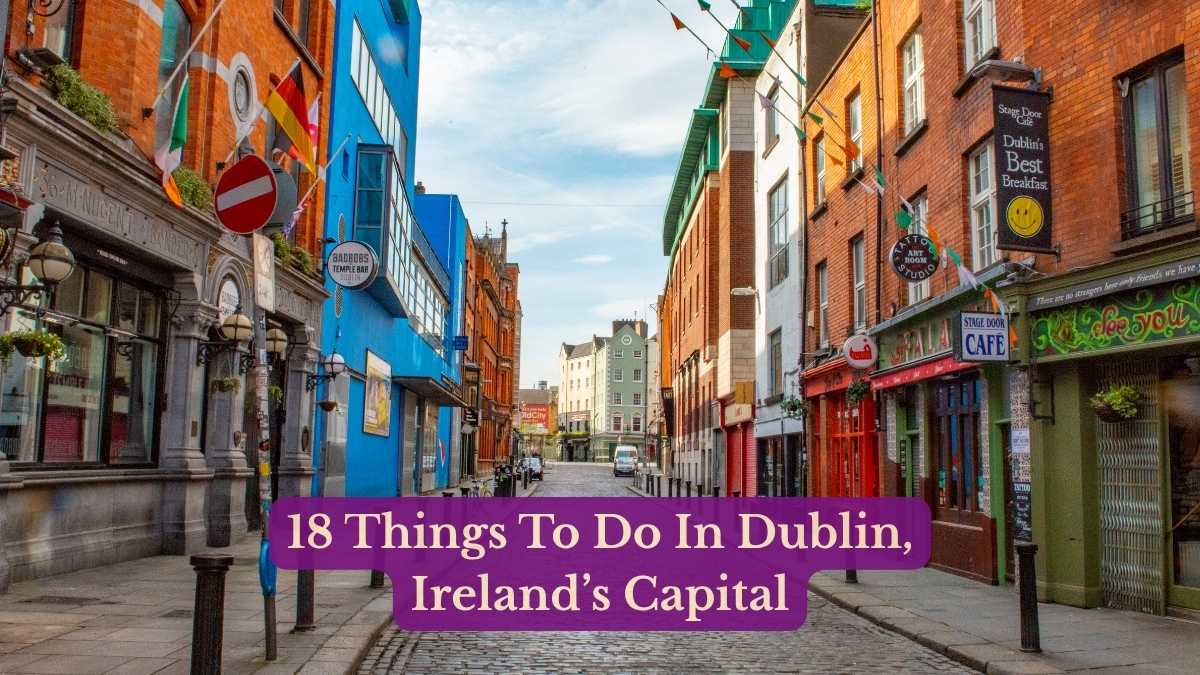
Things To Do In Dublin, Ireland’s Capital: Dublin sits at the mouth of the River Liffey on Ireland’s east coast and packs an extraordinary range of experience into a compact, walkable city. The capital of the Republic of Ireland draws over eight million visitors per year. Most arrive expecting pubs, literary history, and Georgian architecture. They find all three, but the things to do in Dublin extend considerably further.
World-class museums with free admission, one of the oldest universities in the English-speaking world, a Viking heritage that predates the city’s Anglo-Norman phase by 300 years, a coastal hinterland with cliff walks and fishing villages accessible in 30 minutes by public transport, and a food scene that has changed almost beyond recognition in the past 15 years all compete for your attention. Dublin is walkable in a way that few European capitals manage. Most of what matters sits within a 30-minute walk of O’Connell Bridge.
Must Read: 27 Things To Do In Santa Fe, New Mexico
The best things to do in Dublin include visiting Trinity College and the Book of Kells, touring the Guinness Storehouse, exploring Dublin Castle, walking through the National Museum of Ireland, spending an evening in Temple Bar, hiking Howth Head, visiting the Chester Beatty Library, and taking a day trip to Glendalough in County Wicklow.
Things To Do In Dublin, Ireland’s Capital
| Experience | Category | Approx. Cost | Time Needed |
|---|---|---|---|
| Trinity College and Book of Kells | History/Culture | €16/adult | 1.5-2 hours |
| Guinness Storehouse | Culture/Food | €26-€30/adult | 1.5-2 hours |
| Chester Beatty Library | Art/Culture | Free | 1.5-2 hours |
| National Museum of Ireland | History | Free | 2-3 hours |
| Dublin Castle | History | €8/adult | 1-1.5 hours |
| Howth Head cliff walk | Outdoors | Free | 2-3 hours |
| Glendalough day trip | Outdoors/History | Free entry (transport extra) | Full day |
| National Gallery of Ireland | Art | Free | 1.5-2 hours |
Things To Do In Dublin: History and Culture
1. Visit Trinity College and See the Book of Kells
Trinity College Dublin at College Green was founded in 1592 by Queen Elizabeth I on the site of a dissolved Augustinian monastery. It is the oldest university in Ireland and one of the oldest in the English-speaking world. Its 47-acre campus sits in the heart of Dublin city centre and is open to the public as a walkable historic space.
The Book of Kells is an illuminated manuscript gospel book created by Celtic monks around 800 CE, most likely on the island of Iona off the Scottish coast. It was brought to Kells in County Meath following Viking raids and arrived at Trinity in 1661. It is one of the finest examples of Insular art in existence and one of the most visited cultural artefacts in Ireland.
The exhibition presenting the Book of Kells:
- Ground floor gallery covering the history of Celtic Christianity and the manuscript tradition that produced the book
- The manuscript itself, displayed in a climate-controlled case at low light levels to preserve the pigments. Two of the four volumes are displayed open, rotating regularly to different pages.
- Access to the Long Room, the two-storey barrel-vaulted library completed in 1732 that holds 200,000 of Trinity’s oldest books. The Long Room is one of the most photographed interiors in Ireland.
- The Long Room also displays the Brian Boru Harp, the oldest surviving Irish harp, dated to the 14th or 15th century and the model for the emblem on Irish state documents and euro coins.
Admission: €16 for adults, €14 for seniors and students, free for children under 12. Book in advance at booking.tcd.ie to guarantee entry, particularly from May through September when same-day tickets are frequently unavailable.
2. Tour the Guinness Storehouse
The Guinness Storehouse at St James’s Gate Brewery is the most visited paid tourist attraction in Ireland, drawing over 1.7 million visitors per year. The building is a converted fermentation plant constructed in 1904 and now holds a seven-floor exhibition on the history of Guinness, the brewing process, and the brand’s advertising history.
The exhibition includes:
- The atrium at the building’s core, shaped like a giant pint glass rising through all seven floors
- The ingredients and brewing process floors covering water, barley, hops, and yeast
- A Guinness advertising history gallery covering 250 years of campaigns
- A cooperage demonstration area showing traditional barrel-making
- The Gravity Bar on the seventh floor: a 360-degree glass-walled bar serving one complimentary pint of Guinness with admission, with panoramic views of Dublin
Admission: €26 for adults online (€30 at the door). Book at guinnessstorehouse.com. Go on a weekday morning to avoid the peak afternoon crowds. The Gravity Bar gets extremely crowded from 2 PM onward.
Guinness has been brewed at St James’s Gate since 1759, when Arthur Guinness signed a 9,000-year lease on the site at £45 per year.
Also Check: 30 Things to Do in Japan – Region Wise Key Attractions, Activities & Tips
3. Visit Dublin Castle
Dublin Castle at Dame Street has served as the administrative centre of British rule in Ireland for over 700 years. The original Norman castle was built in 1204 on the orders of King John on the site of a Viking fortification. It was the seat of the Lord Lieutenant of Ireland from the 13th century until Irish independence in 1922.
The castle now serves as a government complex used for state occasions and European Union presidency summits. It is also a significant things to do in Dublin destination with guided tours of the state apartments and the underground archaeological excavations.
Guided tour highlights:
- St Patrick’s Hall – A state reception room whose ceiling is painted with scenes of Irish history, used for presidential inaugurations
- The Throne Room – An intact Victorian throne room with the original throne presented to King George IV for his 1821 Dublin visit
- The Undercroft – Archaeological remains of the original 1204 castle foundations, the Viking dark pool that gave Dublin its name (Dubh Linn, meaning black pool), and sections of the original city wall
- The Chapel Royal – An 1814 Gothic Revival chapel with elaborate plasterwork and carved limestone exterior
Admission: €8 for adults, €6 for concessions, free for children under 12. Guided tours depart every 20-30 minutes from the main courtyard.
4. Explore the Chester Beatty Library
The Chester Beatty Library at Dublin Castle grounds is consistently rated among the best museums in Europe and is one of the most genuinely outstanding free things to do in Dublin. It holds the personal collection of American mining magnate and philanthropist Sir Alfred Chester Beatty (1875-1968), who bequeathed his collection to the Irish state upon his death.
The collection spans:
| Collection Area | Objects | Highlights |
|---|---|---|
| Islamic manuscripts | Over 6,000 | Illuminated Qurans from the 9th century onward |
| East Asian art | 1,000+ | Chinese jade books, Japanese woodblock prints |
| Western manuscripts | 300+ | Illuminated European Christian manuscripts |
| Ancient papyri | 150+ | Some of the earliest surviving New Testament texts |
| South Asian art | 750+ | Mughal miniature paintings of extraordinary quality |
The Qur’an collection is one of the finest outside the Islamic world. The collection of Mughal miniature paintings rivals the holdings of major European national collections.
Admission is completely free. The library is open Tuesday through Friday 10 AM to 5 PM, Saturday 11 AM to 5 PM, Sunday 1 PM to 5 PM. Closed Mondays.
5. Visit the National Museum of Ireland
The National Museum of Ireland operates four sites across Dublin and County Mayo. The main Dublin sites are at Kildare Street (Archaeology) and Collins Barracks (Decorative Arts and History). Both are free.
National Museum of Ireland: Archaeology at Kildare Street:
- The Treasury – Holds the Ardagh Chalice, the Tara Brooch, the Cross of Cong, and the Derrynaflan Hoard: four of the most significant surviving objects from Early Christian Ireland
- Prehistoric Ireland – Bog bodies preserved in Irish peat, some dating from the Iron Age. These include Clonycavan Man and Old Croghan Man, both showing evidence of ritual killing
- Viking Ireland – Artefacts from the Wood Quay excavations beneath Dublin’s civic offices, including personal items, weapons, and ship materials
- Egypt – A significant collection of Egyptian antiquities
The Ardagh Chalice, made in the 8th century from silver, gold, and glass, is considered the finest surviving example of Early Christian Irish metalwork. It is one of the most important objects in the museum collections and should not be missed.
Things To Do In Dublin: Literary and Artistic
6. Tour the Writers Museum and James Joyce Sites
Dublin has produced more major writers per capita than almost any other city of its size. Samuel Beckett, James Joyce, Oscar Wilde, W.B. Yeats, George Bernard Shaw, Bram Stoker, Jonathan Swift, and Seamus Heaney are all associated with the city.
James Joyce-specific sites:
- James Joyce Centre at 35 North Great George’s Street: A Georgian townhouse devoted to Joyce’s life and work. Admission €5. Guided walking tours of Joycean Dublin available from €10.
- Sweny’s Pharmacy at Lincoln Place: The pharmacy from which Bloom buys a lemon soap in Ulysses. The original shop is maintained by volunteers who run readings daily. Entry by donation.
- The Martello Tower at Sandycove (10 miles south by DART train): The tower where Joyce briefly lived and which opens Ulysses. Now the Joyce Museum. Admission €8.
The Dublin Writers Museum at 18 Parnell Square holds manuscripts, portraits, letters, and first editions from Irish writers across four centuries. Admission €8.50.
7. Visit the National Gallery of Ireland
The National Gallery at Merrion Square West holds the Irish national collection of European and Irish art and is one of the most significant free things to do in Dublin for visitors interested in painting and sculpture.
The collection includes:
- A major collection of Jack B. Yeats paintings, the largest outside private hands. Yeats is Ireland’s most significant painter of the 20th century.
- Caravaggio’s The Taking of Christ (1602), rediscovered in a Dublin Jesuit residence in 1990 after being misidentified for decades. It now anchors the European old masters rooms.
- Works by Rembrandt, Vermeer, El Greco, Velázquez, and Mantegna
- A substantial collection of Irish art from the 18th century through the present
Admission is free. Open Monday through Saturday 9:15 AM to 5:30 PM, Sunday 11 AM to 5:30 PM. The Caravaggio room is always the most crowded. Visit early or late in the day for space to look at it properly.
Things To Do In Dublin: Neighbourhoods and Walking
8. Spend an Evening in Temple Bar
Temple Bar is Dublin’s cultural quarter, covering a network of cobbled streets and squares between Dame Street and the River Liffey on the south bank. It was threatened with demolition in the 1980s to build a bus depot, preserved by a coalition of artists and cultural organisations, and has operated as a designated cultural district since the early 1990s.
What Temple Bar actually contains:
- The Temple Bar Cultural Trust operates several cultural venues including the Irish Film Institute, the Gallery of Photography, and Project Arts Centre
- The Irish Film Institute at 6 Eustace Street shows independent, foreign language, and archive Irish films. Day membership is free; film tickets cost €12-€14.
- A dense concentration of bars, restaurants, and live music venues. Prices in Temple Bar are notably higher than comparable venues elsewhere in Dublin, but the atmosphere on weekend evenings is genuinely electric.
- The Temple Bar Food Market operates on Saturdays from 10 AM to 4:30 PM in Meeting House Square, with around 30 stalls selling Irish artisan produce
The cobblestoned streets and the concentration of pub culture make Temple Bar one of the most atmospheric things to do in Dublin in the evening, despite its reputation for being overpriced. Drink in the Porterhouse or the Palace Bar on Fleet Street for better value and a more local crowd.
9. Walk the Georgian Squares
Dublin’s Georgian architecture is among the finest surviving Georgian urban streetscape in the world. The four great Georgian squares, Merrion Square, Fitzwilliam Square, St Stephen’s Green, and Mountjoy Square, all date from the second half of the 18th century and represent a unified architectural vision of brick terrace houses with identical floor heights, regular windows, and elaborate doorways.
Walking route connecting the main Georgian areas:
- Start at St Stephen’s Green (public park, free entry, 22 acres)
- Walk east along Merrion Row to Merrion Square (Oscar Wilde’s childhood home is at Number 1, marked with a plaque)
- Continue south to Fitzwilliam Square, the smallest and most intact of the four squares
- Return via Baggot Street, which has retained more of its original Georgian character than any other commercial street in Dublin
The variety in doorway colours, fanlights, and door furniture on Merrion Square makes it the most photogenic stretch of Georgian Dublin. The National Gallery sits on the west side of the square.
10. Explore the Liberties and Kilmainham
The Liberties is the oldest residential neighbourhood in Dublin, immediately west of the medieval city walls and south of the Liffey. It retains its working-class character more authentically than areas that have been gentrified, and it contains several of the most significant things to do in Dublin that tourists often miss.
Key sites in the Liberties and Kilmainham:
- Kilmainham Gaol at Inchicore Road: The prison where the leaders of the 1916 Easter Rising were held and executed. Now a museum of Irish nationalist history. Admission €8/adult. Book in advance at kilmainhamgaolmuseum.ie, as tours sell out weeks ahead in summer.
- St Patrick’s Cathedral at St Patrick’s Close: The national cathedral of the Church of Ireland, founded in 1191 on the site of an older church. Jonathan Swift served as Dean here from 1713 to 1745. Admission €8/adult.
- Christ Church Cathedral at Christchurch Place: The older of Dublin’s two medieval cathedrals, founded by the Norse King Sitriuc in 1028. The crypt beneath the cathedral is the largest medieval crypt in Ireland or Britain. Admission €8/adult.
- The Irish Whiskey Museum at 119 Grafton Street: A guide to Irish whiskey history. Admission €18-€25 including tasting.
Kilmainham Gaol is among the most emotionally significant things to do in Dublin for visitors with any interest in Irish history. The execution yard where the 1916 leaders were shot is still intact.
Things To Do In Dublin: Outdoors and Day Trips
11. Walk the Howth Head Cliff Path
Howth sits at the end of the DART coastal train line, 15 kilometres northeast of Dublin city centre. The DART journey from Connolly Station takes 25 minutes and costs €3-€4 each way.
The Howth Head cliff walk is a 6.5-mile circular route along the northern and eastern face of the Howth peninsula. It follows cliff edges above the Irish Sea with views across Dublin Bay to the Wicklow Mountains and offshore to Ireland’s Eye island.
The route in sections:
| Section | Distance | Character |
|---|---|---|
| Howth village to East Pier | 0.5 miles | Harbour promenade |
| East Pier to Baily Lighthouse | 3 miles | High cliff path, exposed to sea |
| Baily Lighthouse to Sutton | 3 miles | Lower path through heathland |
The cliff section between the summit and Baily Lighthouse provides the most dramatic views. It involves some scrambling over rocky sections and is unsuitable for pushchairs. Wear waterproof shoes regardless of the forecast.
Howth village itself has good fish and chip restaurants operating from the harbour, several fishing-related seafood restaurants, and a small craft market at weekends. Return to Dublin by DART from Howth station.
12. Day Trip to Glendalough
Glendalough (Irish: Gleann Dá Loch, meaning Valley of Two Lakes) sits in County Wicklow, 50 kilometres south of Dublin. It is one of the most significant early medieval monastic sites in Ireland, founded by St Kevin in the 6th century and developed into a major centre of Celtic Christianity.
The site contains:
- A 33-metre round tower built in the 10th-11th century as both a bell tower and refuge from Viking raids. The original wooden door sits 3.5 metres above ground level, accessible only by ladder.
- The Cathedral of St Peter and St Paul, the largest surviving church on the site, built in multiple phases from the 10th through 12th centuries
- St Kevin’s Church (known locally as St Kevin’s Kitchen because the bell tower resembles a chimney)
- Two natural glacial lakes surrounded by the Wicklow Mountains
- Multiple walking trails of varying length through the National Park surrounding the monastic city
Entry to the monastic site is free. The visitor centre charges €5 for adults and provides context through exhibitions and an audio-visual presentation.
Getting there without a car: Go Bus and St Kevin’s Bus operate direct services from Dublin city centre (Dawson Street) to Glendalough. Journey time is approximately 1.5 hours. Return fare costs €24-€26.
13. Walk the South Dublin Coast on the Coastal Trail
The South Dublin coastal area accessible by DART train offers several hours of walking along rocky headlands, sandy beaches, and fishing villages without requiring a car.
Key stops on the DART south from Dublin:
- Dún Laoghaire (20 minutes from city centre): A Victorian harbour town with two granite piers extending into Dublin Bay. Walking both East and West Pier takes 90 minutes and costs nothing.
- Dalkey (22 minutes): A village with a ruined medieval castle, a view of Dalkey Island with its own ruined church, and several well-regarded restaurants. Dalkey was the childhood home of Bono.
- Killiney (25 minutes): A coastal walk from Killiney Station to Killiney Hill Park provides views often compared to the Bay of Naples, looking south along the coast toward Bray Head.
Practical Tips for Visiting Dublin
- Use the DART and Dublin Bus rather than taxis. A Leap Card (€5 deposit, loaded with credit) gives reduced fares across all Dublin transport. The DART coastal line is one of the genuinely scenic urban rail journeys in Europe.
- Book Kilmainham Gaol weeks in advance. Guided tours sell out consistently from March through October and are the only way to access most of the prison interior.
- Book Trinity College and Book of Kells in advance. Same-day tickets are frequently unavailable from May through August. Book at booking.tcd.ie.
- Eat away from Temple Bar for real prices. Restaurants in the Portobello, Rathmines, and Ranelagh neighbourhoods south of the canal, and Smithfield and Stoneybatter north of the Liffey, charge significantly less than the tourist core for equivalent quality.
- Visit the Chester Beatty Library first. It is genuinely extraordinary, completely free, and unknown to most visitors who arrive focused on the Guinness Storehouse and Temple Bar. It deserves as much time as the more famous paid attractions.
- Walk between most major sites. Dublin’s main tourist attractions sit within a 2-kilometre radius of each other. Walking between Trinity College, Dublin Castle, Christ Church, the National Museum, and the National Gallery is more practical and more interesting than taking transport.
Best Time for Things To Do In Dublin
| Season | Conditions | Best Activities |
|---|---|---|
| Spring (Mar-May) | 10-15°C, longer days, pre-peak | Howth walk, Georgian squares, museums |
| Summer (Jun-Aug) | 15-20°C, longest days, busiest | Coastal walks, Glendalough, outdoor events |
| Fall (Sep-Oct) | 10-15°C, fewer crowds, good light | All activities, cheaper accommodation |
| Winter (Nov-Feb) | 5-10°C, short days, lowest rates | Museums, pubs, Chester Beatty, Guinness Storehouse |
September and October are the best overall months for most things to do in Dublin. Summer crowds thin after the school holiday period, accommodation rates drop, and the city returns to a more local rhythm. The light in Dublin in October, when it appears at all, is exceptional.
FAQs: Things To Do In Dublin
How many days do you need for the things to do in Dublin?
Three days covers Trinity College, the Guinness Storehouse, Dublin Castle, Chester Beatty Library, National Museum, Kilmainham Gaol, and an evening in Temple Bar. Four days adds the Howth cliff walk and the National Gallery. Five days allows a full day trip to Glendalough with proper time at the site.
What are the best free things to do in Dublin?
The Chester Beatty Library, National Museum of Ireland, National Gallery, walking Merrion Square, the Howth Head cliff path, exploring the Georgian squares, Phoenix Park (the second-largest enclosed urban park in Europe), and the Dún Laoghaire pier walk are all completely free. Dublin has an exceptional density of free cultural institutions.
Is Dublin walkable for tourists?
Yes, more so than most European capitals. Trinity College, Dublin Castle, Temple Bar, the National Museum, Christ Church Cathedral, and St Patrick’s Cathedral all sit within a 20-minute walk of each other. The north inner city including the Spire and the Writers Museum is 15 minutes from O’Connell Bridge. A car is not needed for the central things to do in Dublin.
What is Dublin most famous for internationally?
Dublin is internationally known for Guinness, James Joyce and its broader literary tradition, the Book of Kells, its pub culture, and its role in Irish independence. The things to do in Dublin most associated with these areas, the Guinness Storehouse, Trinity College, Kilmainham Gaol, and the pub scene in Temple Bar, are all genuinely worth visiting rather than simply famous.
What Irish food should you eat in Dublin?
Traditional Irish fare includes Irish stew (lamb, potato, onion), boxty (potato pancake), colcannon (mashed potato with cabbage and butter), and soda bread. For modern Irish cooking, restaurants including Chapter One, Variety Jones, and Glovers Alley represent the current quality level. The Fallon and Byrne food hall and the English Market-style George’s Street Arcade both have quality Irish produce.
Is Dublin expensive for tourists?
Dublin is among the more expensive European capital cities for accommodation and eating out. Budget accommodation runs €30-€60 per night in hostels. Mid-range hotels cost €120-€200. Most major cultural institutions are free, which significantly offsets costs. Eating at lunch specials rather than dinner, shopping at Lidl and Aldi for picnic supplies, and drinking in non-tourist pubs all reduce daily spending substantially.
Final Words
Dublin delivers best to visitors who slow down enough to notice what sits between the obvious attractions. The things to do in Dublin that stay with you are rarely the Guinness Storehouse alone or Temple Bar at midnight.
They are the morning in the Chester Beatty Library looking at manuscripts that no museum in the world holds with more care, the walk along the Howth Head cliffs with the Wicklow Mountains across the bay, and the pint in a snug in a 19th-century pub where the conversation is genuinely the point.
Come for three days minimum, give the Chester Beatty the morning it deserves, book Kilmainham well ahead, and leave one afternoon genuinely unscheduled. The things to do in Dublin worth remembering are often the ones you did not plan.





Leave a Comment