
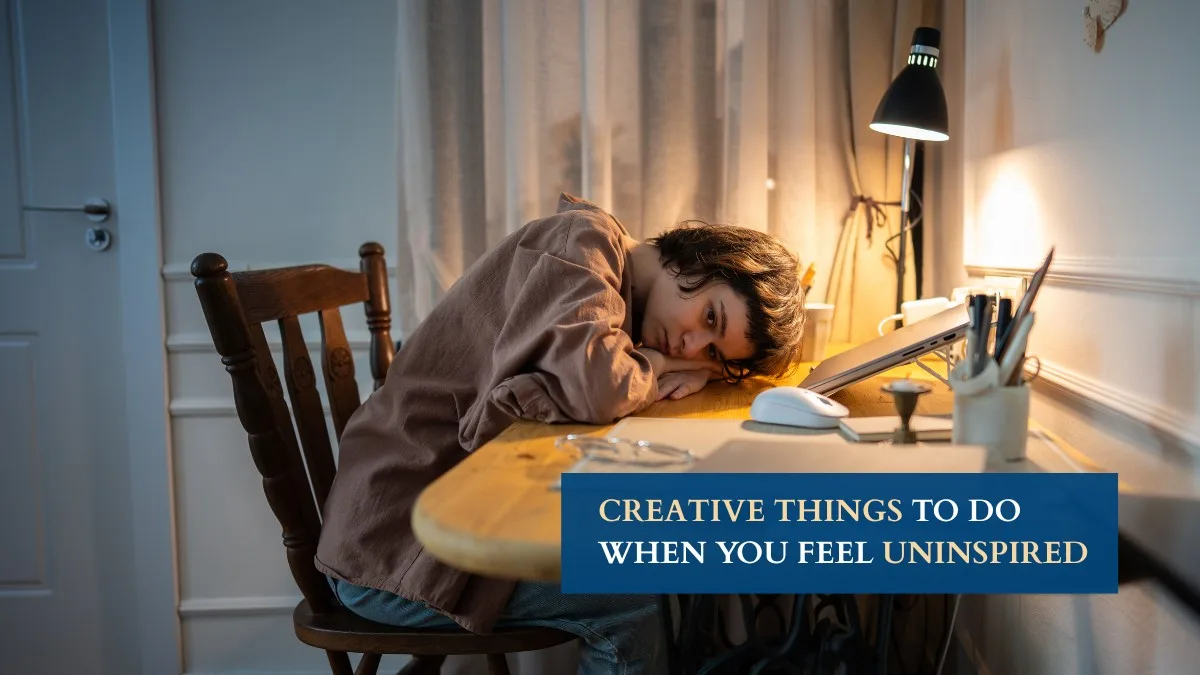
Feeling stuck, unmotivated, or out of ideas can happen to anyone, especially when creativity just doesn’t seem to flow. These moments can be frustrating, but they’re also a natural part of the creative process. If you’re searching for creative things to do when you feel uninspired, there are simple and effective ways to break through the block and get your ideas moving again.
Instead of forcing inspiration, the key is to shift your mindset, explore new activities, and give your brain the space it needs to reset. In this guide, you’ll discover a variety of creative things to do when you feel uninspired that can help spark fresh ideas, boost your imagination, and bring back your creative energy.
Why Creative Blocks Happen and What Actually Helps
Creative blocks are not a character flaw or a sign that your best work is behind you. Neuroscientist Rex Jung at the University of New Mexico found that creative thinking requires the brain to shift between two networks: the default mode network (associated with imagination and daydreaming) and the executive control network (associated with focus and execution). When you feel uninspired, these networks often stop alternating properly. The fix is rarely forcing output. It is usually changing inputs.
The creative things to do when you feel uninspired in this guide are drawn from documented practices used by working writers, artists, designers, musicians, and makers. They are organised by effort level, time required, and the type of creative block they address most directly.
Must Read: Things To Do As A Couple When Bored
Creative Block Solutions At a Glance
The best creative things to do when you feel uninspired include freewriting for 10 minutes without editing, changing your physical environment, looking at art outside your usual medium, taking a walk with no phone, cooking something new, starting a very small creative constraint exercise, or copying the work of someone you admire to study their technique.
| Block Type | Likely Cause | Best Fix |
|---|---|---|
| Blank page paralysis | Perfectionism, fear of starting | Freewriting, constraint exercises, copying |
| General flatness | Depleted inputs, overstimulation | Walk, museum visit, reading widely |
| Stuck mid-project | Too close to the work | Change medium, work on something else |
| Low motivation | Mental fatigue, routine overload | Rest deliberately, change environment |
| Comparison spiral | Social media, peer pressure | Input fast, output slow, digital detox |
| Physical restlessness | Sedentary work habits | Movement-based activities first |
Creative Things To Do When You Feel Uninspired: The Full List
Start Small and Remove Pressure
1. Freewrite for 10 Minutes Without Editing
Freewriting is the practice of writing continuously for a set time without stopping, correcting, or judging what comes out. The rule is simple: keep the pen moving. Julia Cameron, author of The Artist’s Way, recommends three pages of longhand freewriting every morning, which she calls Morning Pages. Research on expressive writing by psychologist James Pennebaker at the University of Texas shows that unstructured writing consistently reduces anxiety and produces creative insight.
How to do it:
- Set a timer for 10 minutes
- Write by hand if possible
- Do not stop, correct, or read back until the timer ends
- Start with the sentence “I don’t know what to write but” if you have nothing
- Throw it away afterward if you want to. The output is not the point.
This is one of the most accessible creative things to do when you feel uninspired because it requires nothing beyond paper and a pen.
2. Use a Creative Constraint
Constraints do not limit creativity. They focus it. Filmmaker Lars von Trier co-created the Dogme 95 movement, which required films to be shot on location with no artificial lighting and no post-production sound additions. The constraint forced genuine creative solutions that open-ended production would never have produced.
Practical constraints by creative medium:
| Medium | Constraint to Try |
|---|---|
| Writing | Write a story in exactly 100 words, no more, no less |
| Visual art | Use only three colours for an entire piece |
| Photography | Shoot only within 10 metres of where you are sitting |
| Music | Compose using only four notes |
| Design | Create a poster using only typography, no images |
| Cooking | Make a meal using only what is currently in your fridge |
Pick one constraint and produce something in under 30 minutes. The smallness of the output removes the pressure that causes most creative blocks.
3. Copy Something You Admire
Copying is one of the oldest and most effective learning tools in creative practice. Painters have copied masterworks in galleries for centuries. Musicians transcribe solos they admire. Writers retype paragraphs they want to study closely. The act of copying moves your hand through choices you would not have made yourself and expands your technical range.
Practical approaches:
- Retype three paragraphs from a writer you admire and notice their sentence structures
- Sketch a painting or photograph you find compelling, not to reproduce it but to understand why it works
- Learn a musical phrase by ear by slowing it down and playing it back in sections
- Recreate a logo or design you find effective and analyse each choice you have to make to reproduce it
Copying for study is not plagiarism. It is a studio practice with centuries of precedent.
4. Set a Terrible First Draft as the Goal
The concept of the terrible first draft comes from Anne Lamott’s 1994 book Bird by Bird, one of the most widely read books on the writing process. Lamott argues that all writers produce terrible first drafts and that giving yourself permission to write badly is the only way to write anything at all. The same principle applies across all creative disciplines.
Give yourself explicit permission to:
- Make something ugly on purpose
- Finish something badly rather than not finish it at all
- Show no one the first version
- Produce quantity over quality for one defined session
A 2014 study published in the Academy of Management Journal found that people told to produce as many ideas as possible, regardless of quality, consistently generated more high-quality ideas than those told to focus on quality from the start.
Change Your Environment and Inputs
5. Go for a Walk With No Phone or Earphones
Walking without a phone is qualitatively different from walking while listening to a podcast. The unstimulated mind starts generating. A 2014 Stanford University study found that creative output increased by an average of 81% during and immediately after a walk compared to sitting. The effect was present for outdoor and indoor walking but was strongest for outdoor walking in natural settings.
A 20-30 minute walk in a park, along a riverside path, or through any green space produces measurable creative benefit. The key is leaving your phone behind or putting it on airplane mode. Your brain needs unscheduled time to make unexpected connections.
6. Visit an Art Gallery or Museum Outside Your Medium
If you are a writer, go look at paintings. If you are a photographer, go listen to live music. If you are a graphic designer, visit a natural history museum. Exposure to creative work in a different discipline disrupts the narrow groove your brain has been working in and introduces new structural patterns.
Free options in most major cities:
- National galleries and municipal art museums (free in most UK cities, free at Smithsonian museums in Washington DC)
- Public sculpture trails in city parks
- Architecture walks in historic districts
- Library exhibitions and reading rooms
Give yourself 90 minutes and write three observations about what you saw before you leave the building. These observations rarely connect directly to your work. That is the point.
7. Read Something Completely Outside Your Usual Genre
Reading outside your genre is one of the most consistently cited creative things to do when you feel uninspired across multiple creative disciplines. Poet Mary Oliver read extensively in natural history. Screenwriter Aaron Sorkin studies music theory. Graphic designer Paula Scher reads history.
Reading lists for cross-disciplinary input:
| Your Usual Area | Read This Instead |
|---|---|
| Fiction writing | Scientific American Mind or popular science |
| Visual design | Poetry collections |
| Music | Architecture history or food writing |
| Photography | Philosophical essays |
| Business writing | Literary short fiction |
| Technical fields | Travel writing or memoir |
A public library card gives you access to this for free. The Libby app connects to most library systems and provides digital borrowing with no waiting list for many titles.
8. Change Where You Work
Your brain associates environments with behaviours. Working at the same desk every day trains your brain to produce the same kinds of thinking. Moving to a different location, even within the same building, changes the environmental cues your brain uses to set its mode.
Options by cost:
- A different room in your home (free)
- A public library reading room (free)
- A cafe for two hours (cost of one drink, $3-$6)
- An outdoor picnic table with a notebook (free)
- A co-working space day pass ($15-$25)
Novelist Kazuo Ishiguro described locking himself in a room in a different house for four weeks to complete The Remains of the Day. Most creative blocks do not require that level of intervention. A different chair in a different room is often sufficient.
9. Collect Images That Attract You Without Analysing Why
Start a physical or digital image collection with no curatorial intention. Pin things that attract you visually without asking yourself why. Pinterest, Are.na, and a physical scrapbook all work. The practice builds an honest record of your visual preferences rather than your intellectual self-image.
After two to three weeks, look at what you have collected. Patterns emerge. These patterns often reveal something about where your creative instincts actually want to go, which is frequently different from where you think they should go.
Also Read: Things To Do With Friends On A Budget
10. Watch a Documentary About a Creative Process
Watching how other people work and solve problems reactivates your own creative thinking. Strong options by creative field:
| Documentary | Subject | Platform |
|---|---|---|
| Jiro Dreams of Sushi (2011) | Mastery and craft | Netflix |
| Abstract: The Art of Design (2017) | Various design disciplines | Netflix |
| Exit Through the Gift Shop (2010) | Street art and authenticity | Rent/Buy |
| The Creative Brain (2019) | Neuroscience of creativity | Netflix |
| I Am Chris Farley (2015) | Comedy craft and process | Peacock |
| Making a Murderer (2015) | Narrative documentary craft | Netflix |
Work With Your Hands
11. Cook Something You Have Never Made Before
Cooking engages your hands, your senses, and your problem-solving ability simultaneously. It is one of the most effective creative things to do when you feel uninspired precisely because it is not your main creative discipline. The creative pressure is absent. The sensory engagement is immediate.
Effective approaches:
- Pick a cuisine you have never cooked and buy ingredients for one dish
- Choose a technique you have avoided (laminated dough, tempering chocolate, making stock from scratch)
- Cook from a single book rather than searching the internet
- Give yourself two hours and cook without checking your phone
The meal at the end makes the activity feel justified regardless of the creative work it does internally.
12. Work With a Physical Material
Spending time with a physical material produces different neurological effects than screen-based creative work. Activities that work well for crossing into physical making:
- Clay or air-dry modelling clay ($5-$15 for a starter pack)
- Linocut printmaking ($15-$25 for a starter kit, produces repeatable prints)
- Hand lettering with a brush pen ($8-$12 for a basic set)
- Embroidery or cross-stitch from a beginner kit ($10-$20)
- Woodcarving with a basic knife and soft wood ($15-$25 to start)
None of these require skill to begin. The unfamiliarity of a new material is part of what makes it useful.
13. Rearrange a Physical Space
Reorganising a room, a bookshelf, or a studio forces spatial decision-making that uses your creative brain without the pressure of producing creative work. Many writers and artists describe major reorganisations of their workspace as a reliable way back into productive work. The act of creating order where there was disorder mirrors the act of shaping raw material into finished work.
14. Garden or Work Outside
Gardening specifically, as opposed to general outdoor time, produces measurable reductions in cortisol according to a 2011 study published in the Journal of Health Psychology. Participants who spent 30 minutes gardening after a stressful task showed lower cortisol and improved mood compared to those who spent the same time reading indoors.
You do not need a garden. A balcony with pots, a window box, or a community garden plot all produce the same engagement with physical material, seasonal change, and the satisfaction of producing something living.
Creative Practices That Build Over Time
15. Keep a Notebook of Things You Notice
Carry a small notebook and write down one observation per day. Not ideas. Observations. What you saw, heard, smelled, or noticed that was specific and concrete. David Sedaris has kept notebooks of overheard conversations for decades and describes them as his primary source material. The practice trains attention and produces a bank of material you did not know you were collecting.
Practical formats:
- One overheard sentence per day
- One image or scene described in two sentences
- One question the day raised
- One thing that surprised you
- One thing you saw that you cannot explain
16. Start a 30-Day Creative Challenge
A 30-day challenge with a single narrow brief removes daily decision fatigue from creative work. The brief must be specific:
- One drawing of something in your immediate environment per day
- One photograph of a shadow per day
- One haiku per day
- One 200-word short story per day
- One new recipe per week
Instagram and Behance host public 30-day challenges across multiple disciplines if external accountability helps. The specific brief matters more than the medium.
17. Create a Mood Board for a Project That Does Not Exist Yet
Build a visual or conceptual mood board for a project you have not committed to making. Remove the pressure of actually making it. The mood board becomes a container for your current aesthetic interests without requiring you to produce finished work.
Tools for digital mood boarding:
| Tool | Cost | Best For |
|---|---|---|
| Are.na | Free (basic tier) | Research-heavy, conceptual projects |
| Free | Visual image collection | |
| Milanote | Free (basic tier) | Mixed media, design projects |
| Physical pinboard | Cost of a board, $10-$20 | Tactile learners, studio workers |
18. Interview Someone Whose Work You Respect
Asking someone about their creative process generates ideas and reactivates your own. You do not need a formal interview. A coffee conversation with a question at the centre works. Ask: How do you start a new project? What do you do when you are stuck? What was the last thing you made that surprised you?
Most working creatives are willing to have this conversation. The insights tend to be practical and specific in ways that published interviews are not.
Rest and Input as Creative Strategy
19. Rest Deliberately Rather Than Passively
Passive rest, which is scrolling a phone while sitting on a sofa, does not restore creative thinking capacity. Active rest does. Active rest means doing something low-demand that is genuinely different from your work:
- A bath with no phone
- A walk in a specific direction with no destination
- Sitting in a park without reading or listening to anything
- A nap of 20-25 minutes (NASA research found that a 26-minute nap improved cognitive performance by 34% in pilots)
Cognitive neuroscientist Mary Helen Immordino-Yang at USC found that the brain’s default mode network, which generates creative thinking, only activates fully during genuine rest states. Passive screen use does not produce this state.
20. Do a One-Day Digital Detox
Spend one day without social media, news, or entertainment streaming. The first four hours of a digital detox feel uncomfortable. The second four hours often produce the most spontaneous creative thinking people have experienced in months. The discomfort in the first phase is the sound of your brain adjusting from reactive mode to generative mode.
This is one of the most effective creative things to do when you feel uninspired and also the one most people avoid precisely because it feels like doing nothing.
Creative Things To Do When You Feel Uninspired: By Time Available
| Time Available | Best Activity |
|---|---|
| 10-15 minutes | Freewrite, one constraint exercise, write three observations |
| 20-30 minutes | Walk without phone, copy a passage or image for study |
| 45-60 minutes | Cook something new, visit a gallery, change your work location |
| 2-3 hours | Read outside your genre, start a mood board, work with a new physical material |
| Half day or more | 30-day challenge kick-off, digital detox, major workspace reorganisation |
Creative Things To Do When You Feel Uninspired: By Creative Discipline
| Discipline | Most Targeted Activities |
|---|---|
| Writing | Freewriting, copying admired prose, reading outside genre, notebook of observations |
| Visual art | Work in a different medium, museum visit, constraint exercise, image collection |
| Music | Transcribe by ear, compose with four notes only, listen to non-music art forms |
| Design | Read poetry, visit natural history museum, create without a client brief |
| Photography | Shoot within 10 metres only, go somewhere unfamiliar, study painters’ compositions |
| Any discipline | Walk without phone, rest deliberately, 30-day challenge, copy and study |
FAQs: Creative Things To Do When You Feel Uninspired
What is the fastest way to feel creative again when you feel uninspired?
A 20-minute walk without your phone is the fastest documented method. A 2014 Stanford study found creative output increased by 81% during and after walking. If you cannot go outside, set a 10-minute freewriting timer. Both methods work in under 30 minutes with no preparation required.
How long do creative blocks typically last?
Creative blocks range from hours to months depending on their cause. Blocks caused by mental fatigue typically resolve within days of rest. Blocks caused by fear of failure or comparison to others can persist for months without deliberate intervention. Changing creative inputs and removing performance pressure are the two most consistent evidence-based approaches.
Are creative things to do when you feel uninspired different for different art forms?
The starting point differs by discipline but the underlying principles are consistent. Writers benefit most from reading outside their genre and freewriting. Visual artists benefit most from working in unfamiliar physical materials. Musicians benefit from studying non-musical art forms. All disciplines benefit from walking, rest, and environmental change.
Does social media make creative blocks worse?
Yes, consistently. Researcher Ethan Kross at the University of Michigan found that passive social media consumption increases social comparison and reduces mood. Both effects suppress the psychological safety that creative risk-taking requires. Limiting social media use during a creative block, particularly passive scrolling, reduces the comparison spiral that extends most blocks significantly.
What are good creative things to do when you feel uninspired but have very little time?
A 10-minute freewrite, one constraint exercise, writing three observations in a notebook, spending 15 minutes copying something you admire, or sitting quietly for 10 minutes with no screen all fit into tight schedules. Small deliberate inputs consistently outperform waiting for a large block of time that feels right.
Should you push through a creative block or rest?
Both approaches work in different circumstances. If the block stems from mental fatigue or depletion, pushing harder produces worse work and extends the block. If the block stems from avoidance or perfectionism, deliberate action (freewriting, constraint exercises, copying) works better than rest. Identifying which type of block you have determines which response is most useful.
Final words
The most effective creative things to do when you feel uninspired share one characteristic: they shift your brain from output pressure to input mode. Walking, reading widely, working with unfamiliar materials, copying work you admire, and resting deliberately all do this in different ways. The creative things to do when you feel uninspired that work fastest are almost always the simplest ones: ten minutes of freewriting, a walk without your phone, a visit to somewhere visually rich. Start with one of those tonight rather than planning a more elaborate intervention tomorrow.


Leave a Comment